The digital infrastructure for Fab Cities
INTERFACER was an EU ERDF-funded collaborative project aimed at developing an open-source-based digital infrastructure for Fab Cities. The goal was to create the Fab City Operating System (Fab City OS): a federated platform designed to support sustainable, resilient, and locally rooted production systems.
The project laid the technical groundwork for a distributed network in which cities and regions can cooperate globally while producing locally. The focus was on establishing a decentralized digital infrastructure for open-source hardware, circular production, and digital product passports.
Intro
Aims of the INTERFACER project
- Identification, definition, and design of interfaces between systems, networks, and physical artifacts
- Development of Fab City OS: Building an open-source software infrastructure to coordinate local production based on globally shared knowledge
- Implementation of a Digital Product Passport (DPP): Tracking materials and products throughout their entire lifecycle
- Development of a Federated Network Architecture: Local Autonomy and Global Cooperation
- Development of an open-source hardware toolchain: Design, documentation, and manufacturing of open-source hardware
- Active community engagement through workshops, stakeholder forums, and public relations
Key results
Fab City Operating System (FCOS)
The Fab City Operating System is a decentralized infrastructure designed to support open-source hardware collaboration, secure identity management, and fair compensation throughout the entire design and manufacturing cycle. The open-source platform, developed as part of the INTERFACER project, supports Fab Labs, cities, and regions in establishing and operating a decentralized local value creation system by matching local demand for physical artifacts with local production capacities and other services. More information on FCOS here.
It features a passwordless, EDDSA-based cryptographic wallet system that is W3C DID-compliant, supports blockchain-anchored Digital Product Passports (DPP) for asset traceability, and enables secure, traceable contributions to designs, products, and services.
The platform integrates tools for importing and enhancing open-hardware documentation (e.g., from GitHub, GitLab, LOSH) and includes additional components for deployment management, website creation, and community hubs, FabAccess for machine access control, and the OSH Toolchain for metadata automation and compliance with the Open Know-How standard—together, these elements foster a federated, transparent, and fair digital manufacturing ecosystem.
Fab City OS Core
This component includes tools designed to facilitate collaborative processes and ensure fair compensation throughout the entire design and manufacturing cycle. It utilizes cryptographic technology to ensure data protection, transparency, and data sovereignty. A blockchain-based digital product passport enables the traceable documentation of the asset lifecycle. (Detailed information here).
Repository Link: Interfacer · GitHub
Fab City OS Suite
This component offers Fab Cities and their members an easy way to create their own websites using a consistent Fab City design and open-source workflows. It is based on Astro and includes specific features such as a knowledge management system and a member and event directory. You can switch systems at any time.
The suite includes all the digital tools needed to set up and operate a Fab City in a single package that can be installed on your own local server.
Repository Link: Fab City OS Suite · GitLab
Digital Product Passport
The Digital Product Passport (DPP) contains structured product information, including data on sustainability, to promote circular processes such as reuse and repair. Stored on a blockchain, it ensures reliable data, reduces costs, and fosters global collaboration. The DPP also supports recycling, disassembly, and green practices. Access is possible, for example, via a QR code and is integrated into Fab City OS Core. Learn more here.
Creative Flows
The “Creative Flows” concept in the Fab City OS Core enables fair compensation for open-source contributions. It standardizes the sharing and tracking of open hardware, promotes global collaboration, and uses blockchain technology to ensure equitable revenue distribution. The goal is a decentralized, fair economic model. Learn more here.
Fab City Index
Testing and evaluating a method for assessing and monitoring the circularity status of a Fab City.
Open Toolchain Foundation
Promoting and supporting the further development of open-source software required for the development of open-source hardware.
Your Idea. Made in Hamburg.
The Maker Challenge Hamburg (April–May 2022) was an open ideas competition organized by Fab City Hamburg as part of the EU project INTERFACER. The goal was to gather local, socially or environmentally beneficial product ideas from the public (individuals, schools, groups) that could be manufactured in Fab Labs or Open Labs—in line with the principles of the circular economy. MAKER CHALLENGE – Fab City Hamburg Innovation Community
95 idea submissions—ranging from bicycle lights to smart trash cans and wheelchair-accessible stair lifts. Photo: CC BY-SA 4.0 / Laura Müller
Photo: CC BY-SA 4.0 – interfacer.eu / Laura Müller
Our Maker Challenge winners with their product idea for a portable filter cap—always clean drinking water when outdoors. Photo: CC BY-SA 4.0 / Dawid Jakubowski (#tfom23)
Realization of over 20 prototypes, which were presented to the public at the the future of making conference in March 2023. Pictured here: The “Circular Screwdriver” from INDEED. Photo Credits: CC BY-SA 4.0 / Dawid Jakubowski
Cans made from recycled coffee grounds using a 3D printer. Photo credits: CC BY-SA 4.0 / Dawid Jakubowski (#tfom23)
Hydroponic from Hamburg – Healthy and robust plants with minimal water consumption. Photo Credits: CC BY-SA 4.0 / Dawid Jakubowski (#tfom23)
The modular, open-source microscope — PlanktoScope. Photo credits: CC BY-SA 4.0 / Dawid Jakubowski (#tfom23)
Build Workshops
“Education for All” was a three-month series of free workshops on sustainability, open-source principles, and production techniques. Participants worked together to build products and prototypes at Fab Labs in Hamburg—based on openly licensed documentation that allows for global replication and adaptation. The projects also served as use cases for mapping manufacturing processes in the Fab City OS Core. Repository links: INTERFACER – OSH Build Workshops · GitLab
the future of making
After nearly two successful years, the EU project INTERFACER came to an end in March 2023. At the closing event, the future of making Conference + Expo, visions for a locally producing, globally connected city of Hamburg were shared, and paths toward a circular economy were discussed. The project laid the foundation for the digitalization of local production, international collaborations, and a strong maker scene in Hamburg—as a response to global challenges such as climate change.
United Globally – Representatives from the Fab City Global Initiative, Fab City Hamburg, dyne.org, HIWW, New Production Institute, Inmachines, OpenToolchain Foundation at #tfom23. Photo: CC BY-SA 4.0 / Dawid Jakubowski
Dr. Tobias Redlich, Academic Director of the New Production Institute. Photo credits: CC BY-SA 4.0 / Dawid Jakubowski (#tfom23).
Official launch of the OpenToolchain Foundation, which emerged from the Interfacer project. Photo Credits: CC BY-SA 4.0 / Dawid Jakubowski
Panel discussion with Sarah Prien (House of All) and Nadine Herbrich (recyclehero). Photo credits: CC BY-SA 4.0 / Dawid Jakubowski (#tfom23)
Photo Credits: CC BY-SA 4.0 / Dawid Jakubowski (#tfom23)
Daniele Ingrassia, founder and CEO of Inmachines, at the OpenLab Microfactory, on display at #tfom23. Photo: CC BY-SA 4.0 / Dawid Jakubowski
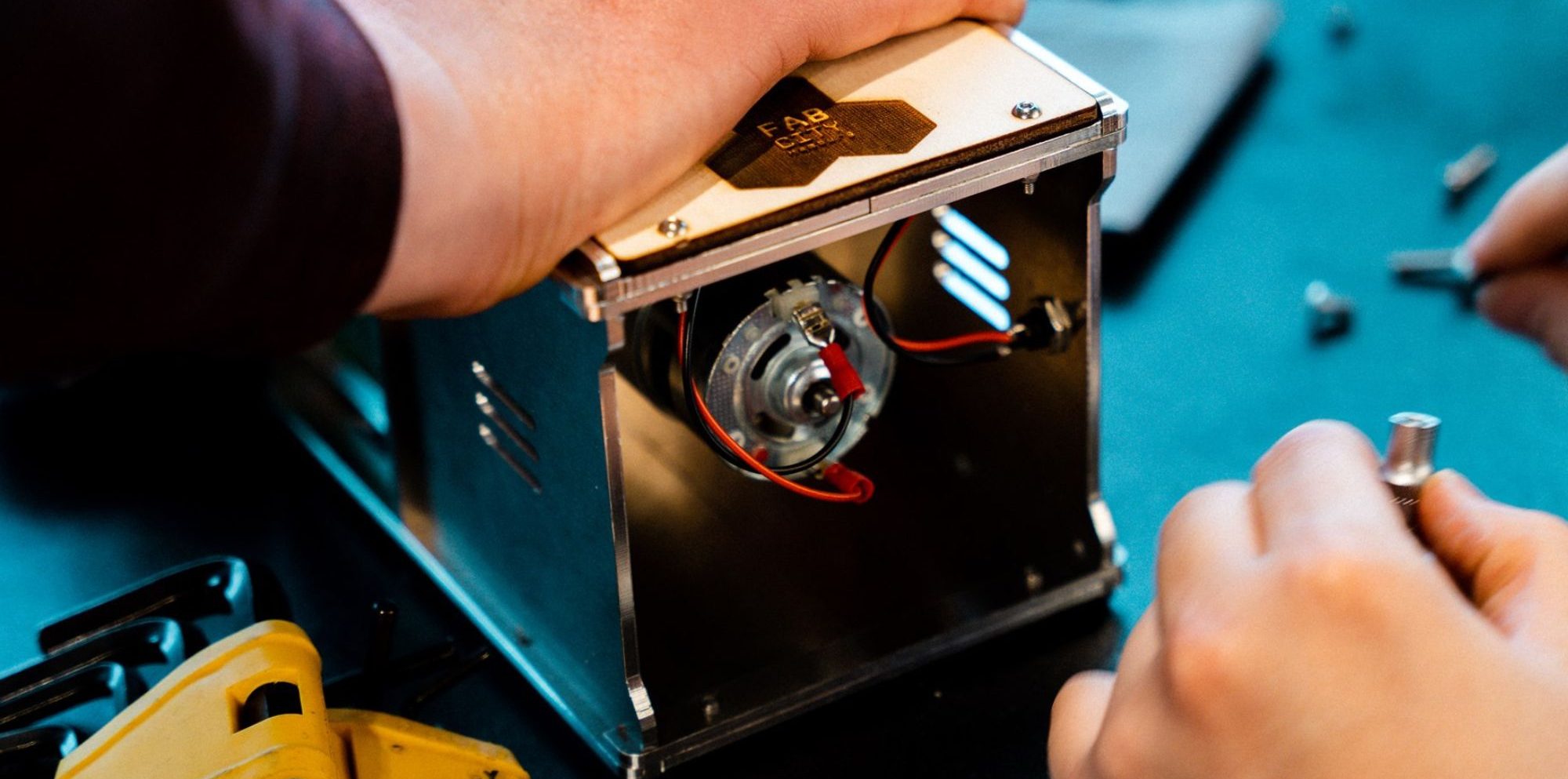
An open-source coffee grinder made using a laser cutter and a CNC router. All parts are repairable and replaceable. Available here on GitHub. Photo: Dawid Jakubowski.
The five Hamburg principles of circular design
The Circular Design Deep Dive event took place from June 22–24, 2022, as part of the INTERFACER project in collaboration with Fab City Hamburg and the Design Zentrum Hamburg. It featured presentations, discussions, and workshops with international experts. Through a co-creative process, five principles for circular design were developed. These were based on 15 theses that emerged from speaker inputs, were discussed with the audience, and further developed in workshops.
Fab City Operating System
INTERFACER
Building the Digital Infrastructure for Fab Cities
The need to reorganize globalized value-added and production systems and to establish sustainable and synergistic production processes worldwide was the starting point for the INTERFACER project. The goal is to develop, implement for the first time, and disseminate an open-source software system called Fab City OS (OS = Operating System), which can be implemented as a software stack along the value chain at the respective units of the global network — e.g., Fab Cities, Fab Labs—to build and operate a local yet globally networked value creation system.
Conference and Expo
the future of making
At the the future of making conference, we worked with local and international changemakers to refine a vision for Hamburg as a locally productive, globally connected city. The focus was on the circular economy, circular design, and the question of how digitalization and collaboration can drive this transformation. Projects like Fab City Hamburg and INTERFACER demonstrate that “the future of making” is interconnected, sustainable—and starts right here. Thank you to all the speakers, makers, and co-creators for these inspiring days full of ideas, energy, and a sense of new beginnings!
Consortium partners
Project title & duration
- INTERFACER – Building the Digital Infrastructure for Fab Cities
- 2021-2023